 Yearnfinance
 vaults, governance, and automated DeFi yield
Yearnfinance pools crypto assets in yVaults that automate yield strategies across decentralized finance protocols. Smart contracts manage invested capital and reinvest strategy earnings, reducing repeated manual transactions. Its broader product range includes governance-linked yLockers, YFI staking, and lending-market curation. These products differ in their accepted assets, income sources, and exit conditions. A vault share represents ownership in an investment pool; a yLocker token represents an underlying governance lock.
Table of contents
The deposit asset and strategies determine the vault's exposure
A vault puts its accepted asset into defined strategies, so exposure depends on both the asset and those strategies. A direct deposit uses the vault's underlying token. The underlying token may itself represent assets in a liquidity pool. In that case, the deposit already carries the pool's exposure before Yearn applies its strategies.
ETH, USDS, USDC, and crvUSD appear among Yearn's asset-focused offerings. The underlying token identifies what a vault accepts; its strategy allocation identifies where that capital works. V3 can support different vault configurations for the same asset. Each deployment belongs to a particular network, so the network and contract address are part of the position's identity.
Harvesting and rebalancing perform different jobs
Harvesting handles strategy earnings, while rebalancing changes where the vault's capital works.
Reinvesting strategy earnings
Strategies may earn lending interest, trading fees, or incentive tokens, depending on the protocols they use. Compounding reward tokens can require converting them into the vault's underlying asset. Reinvestment then increases the capital working inside the strategy. Transaction costs influence when those operations make economic sense, so earned rewards do not necessarily become compounded capital immediately.
V3 accounting also separates accrued income from recorded profit. A Tokenized Strategy recognizes gains or losses through its reporting process. An Allocator Vault then processes the strategy's reported value for its own accounting. Profit unlocking can spread the effect on share value over a configured period.
Allocating capital between strategies
Rebalancing adjusts exposure to available yield opportunities. In a V3 Allocator Vault, moving capital changes which strategy uses the assets; reporting updates the recorded investment result. The selected strategies and management configuration govern those changes. A single-strategy position has no allocation across multiple strategies to manage.
What changes between V2 and V3 vaults?
V3 makes strategies independently usable ERC-4626 vaults, while V2 strategies attach to a particular vault. ERC-4626 standardizes the asset-and-share interface for tokenized vaults. V2 remains relevant for liquidity-pool positions, including Curve vaults; V3 has largely replaced it for single-asset products. V1 vaults are mostly phased out, so older descriptions can concern a different generation.
| Vault structure | Allocation and risk exposure |
|---|---|
| V2 yVault | Vault-specific strategies expose capital to the protocols they use. |
| V3 Tokenized Strategy | A single strategy deploys assets to its external yield source. |
| V3 Allocator Vault | Capital goes to selected strategies; exposure follows those allocations. |
A Tokenized Strategy can accept deposits directly and can also supply yield to an Allocator Vault. Those uses share strategy exposure even when the surrounding products differ. Multiple strategies can diversify allocations, yet each additional protocol introduces another possible source of failure.
Shares and the return displayed in the application
The share balance measures ownership; the asset value per share measures how much underlying capital that ownership represents. A vault can earn income without increasing the number of shares held by a depositor. The conversion between shares and underlying assets captures that accounting change. A wallet's share count therefore answers a different question from its underlying-asset balance.
Annual percentage yield, or APY, expresses an annualized return with compounding. A displayed estimate uses the methodology and observation period for that product. Historical share-price movement does not establish the return over a future holding period. Asset-denominated yield also leaves changes in the underlying token's market price outside that calculation.
Protocol fees and transaction costs
Vault charges and blockchain transaction costs reduce returns through different mechanisms and use different calculation bases. A performance fee applies to earned yield. A management fee, where configured, accrues against managed capital over time. A charge on profit does not take the same amount as an equal rate on the whole position. Fee settings vary by vault, so the product and version determine the applicable configuration.
The application presents net APY with vault fees and compounding taken into account. Separate transaction costs arise from network operations that enter or exit a position. Pooling shares some strategy operating costs across depositors, but a depositor's own transactions still affect returns. Shorter holding periods leave less accumulated yield to absorb those costs.
yLockers connect governance locks with tradable tokens
yLockers turn external governance locks into transferable tokens, changing access to governance benefits and the way a position exits.
Locked backing and market liquidity
yCRV represents CRV committed to Curve's vote-escrow system through Yearn. The backing remains locked, and yCRV cannot be redeemed for that underlying CRV. Transfers and decentralized-exchange trading provide a separate way to change ownership. A market sale uses the available price and liquidity, so it does not promise the same value as the locked token.
Stablecoin rewards or additional yCRV
Staking through YearnBoostedStaker earns rewards derived from crvUSD revenue, delivered as yield-bearing Yearn vault tokens. The auto-compounding vault uses rewards to acquire and restake more yCRV. Unstaking yCRV from the staking contract releases the yLocker token; it does not unlock the underlying CRV. Direct rewards depend on stake weight, and a new stake becomes eligible after its first weekly weight increase. The whitelisted auto-compounder earns maximum boost immediately on reinvested yCRV.
YFI staking and governance participation
YFI supplies Yearn's governance staking system, where stYFI and stYFIx serve different voting preferences.
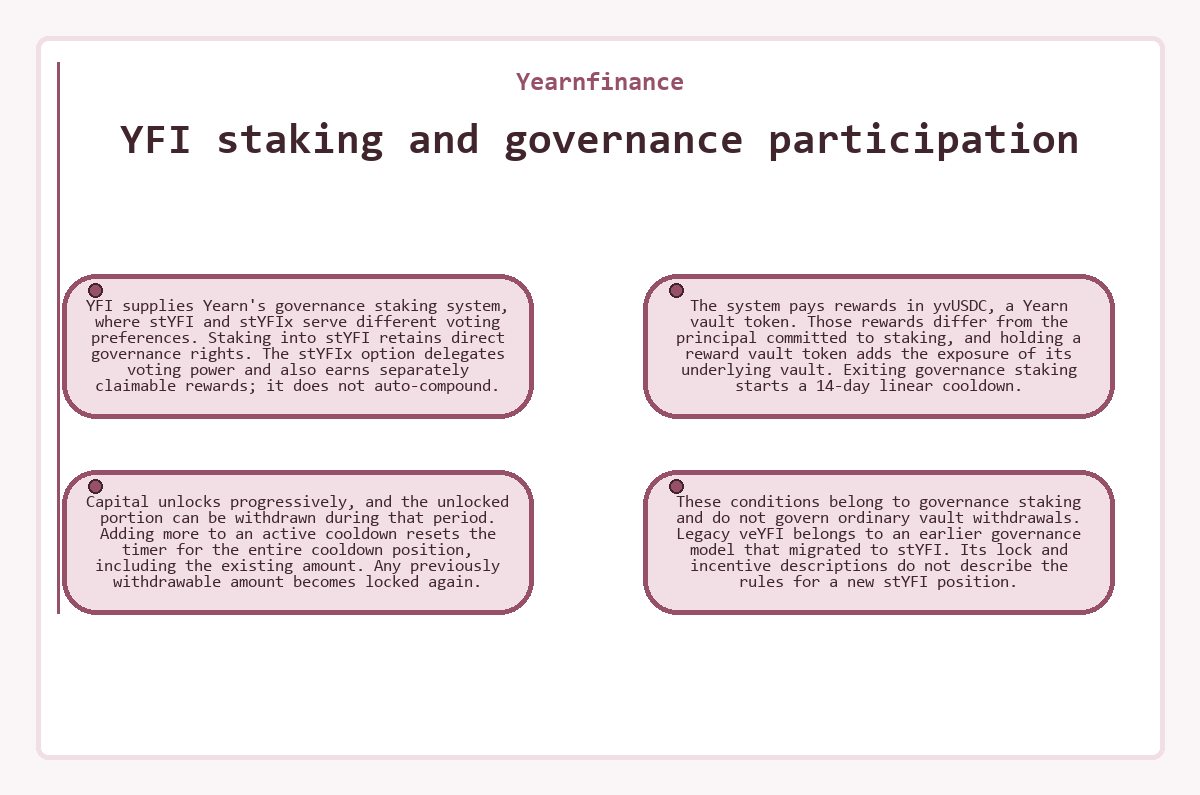
Staking into stYFI retains direct governance rights. The stYFIx option delegates voting power and also earns separately claimable rewards; it does not auto-compound. The system pays rewards in yvUSDC, a Yearn vault token. Those rewards differ from the principal committed to staking, and holding a reward vault token adds the exposure of its underlying vault.
Exiting governance staking starts a 14-day linear cooldown. Capital unlocks progressively, and the unlocked portion can be withdrawn during that period. Adding more to an active cooldown resets the timer for the entire cooldown position, including the existing amount. Any previously withdrawable amount becomes locked again. These conditions belong to governance staking and do not govern ordinary vault withdrawals.
Legacy veYFI belongs to an earlier governance model that migrated to stYFI. Its lock and incentive descriptions do not describe the rules for a new stYFI position.
Curation changes the markets behind a lending vault
Yearn Curation selects lending markets and allocations on Morpho, making market composition part of the yield decision. A Morpho vault can keep the same contract code while changing the markets that receive its funds. That changes the collateral and liquidity risks behind the vault. Yearn monitors market conditions and adjusts allocations within constraints such as supply caps and utilization limits. These constraints influence which opportunities the curator can use and how much capital each market receives.
Public curation data includes risk assessments, token exposures, and market information. These describe an evolving investment position. A strategy that deposits into a curated lending vault inherits the exposures behind that vault. Reallocation can respond to changing conditions, although an alert or attempted withdrawal cannot create liquidity that a lending market lacks.
Applications built around Yearn vaults
Applications can incorporate Yearn vault positions through the same standardized asset-and-share relationships that support direct V3 deposits. The modular architecture separates core vault functions from optional components that manage allocations, fees, or limits. An integration therefore uses a particular vault configuration, even when its interface follows a common standard. Contract compatibility describes how the components connect; the selected strategies determine where the invested capital goes.
Yearn X presents selected partner products through dedicated interfaces. That changes how opportunities are grouped across ecosystems. The vault's underlying asset, network deployment, and strategy exposure remain part of the position wherever an application displays it. A common interface does not establish that every product exists on every network.
Can audits remove the risks of a vault?
No audit removes a vault's exposure to contract failures, strategy mistakes, or the external protocols holding its capital. Audits examine particular contract versions and components. Yearn's V2 and V3 core contracts have undergone external reviews, alongside reviews of strategies and other components. A core-contract audit does not cover every possible strategy, manager configuration, or external market. Governance permissions also create a trust assumption because compromised privileged roles can change how vaults operate.
Yearn vaults inherit the risks of the underlying protocols that their strategies use. Lending strategies can lose capital when collateral fails to cover debt. High utilization can also leave lent assets unavailable for withdrawal. Liquidity-providing strategies can underperform holding the same assets when relative token prices change. Leveraged strategies introduce liquidation risk.
Spreading capital across strategies changes concentration, but it also creates more contract dependencies. Shared collateral or protocols can leave different positions exposed to the same failure. Monitoring and risk scores guide allocation decisions, and their usefulness depends on the conditions that their assessments describe.
Withdrawal liquidity and the limits of automation
A vault withdrawal depends on recoverable underlying assets, available liquidity, and the limits configured for that position. V3 exposes deposit and withdrawal limits for the relevant address. Assets deployed through a strategy may need to return from another protocol before the vault can release them. A heavily utilized lending market can delay that recovery. Strategy losses can also affect the amount returned, making an exit balance different from the original deposit or an annualized yield estimate.
Some vault interfaces offer zaps that convert between the vault asset and another token. These routes depend on actual availability and introduce swap pricing and slippage. A direct underlying-asset withdrawal and a converted withdrawal therefore have different execution conditions. Automated yield management cannot supply a missing conversion route or release assets that remain unavailable in an underlying protocol.
Yearnfinance questions, answered
-
Can I deposit into a Yearn vault without holding YFI?
- YFI is not a general prerequisite for vault deposits. The selected vault must accept the token being deposited, and network transactions also require gas. Staking YFI for governance is a separate use of the token with its own position and exit conditions.
-
Why might a Curve vault withdrawal return a liquidity-pool token?
- A direct withdrawal from a Curve LP-token vault returns its underlying pool token. The assets represented by that token remain inside the Curve pool. Exiting the pool position is another operation with its own conditions; a supported zap may combine conversion into an available withdrawal route.
-
Where could my vault tokens be if the withdrawal panel shows no balance?
- An additional staking contract can hold the vault's receipt shares after a deposit that includes staking. In that case, the wallet's directly held share balance excludes the staked position. The staking balance accounts for those shares, and unstaking must precede a direct vault withdrawal. This explanation applies only when the deposit actually used that staking route.
-
Are balances in Yearn vaults private?
- Yearn vault activity is public on the blockchain. Contract records expose address-level transactions and balances, so an application's account view does not provide transaction confidentiality.
-
Is yPRISMA still an active Yearn yLocker?
- yPRISMA has been deprecated, so its historical earning arrangements do not describe an active yield product. Yearn's deprecation notice describes migration of yPRISMA into a vesting allocation of Resupply's RSUP token.