 Yearnfinance
 vaults - strategy allocation and shares
Yearnfinance vaults allocate deposited assets to yield strategies and issue shares that represent a proportional interest in vault assets. A V3 position may hold shares in a standalone Tokenized Strategy or an Allocator Vault containing several strategy positions. This distinction affects which exposures a deposit creates and where reported profits enter the accounting. Returns can increase the assets that each share represents, while losses can reduce that amount. A withdrawal also needs accessible underlying assets. Understanding the selected vault therefore starts with its accepted token, strategy allocation, reporting process, and exit liquidity.
Key takeaway: A vault share tracks a claim on underlying assets, while vault accounting determines its asset equivalent and accessible liquidity constrains redemption.
Allocations transmit strategy gains and losses to shares
An Allocator Vault holds positions in strategies, so changes in their asset values affect the assets represented by its own shares. Allocation determines which strategies contribute those gains and losses.
Deposited capital can remain idle in the vault or move into strategies configured for that vault. Each strategy applies its own yield mechanism to the underlying asset. The vault records the capital allocated to a strategy as debt, then compares that recorded amount with the position's value during reporting. Here, debt describes the vault's allocation to a strategy; it does not mean that every depositor has borrowed money.
Reallocation changes the distribution of capital between strategies. Optional V3 Debt Allocator contracts help manage those allocations, while the core vault handles deposits, shares, and accounting. The accepted asset can stay unchanged even when its yield sources change, making the strategy mix relevant throughout the holding period.
Multiple strategies spread exposure across positions while introducing additional contracts and protocol dependencies. Diversification therefore changes the composition of risk without eliminating losses.
V3 separates Tokenized strategies from Allocator Vaults
V3 supports direct deposits into a Tokenized Strategy and deposits into an Allocator Vault that distributes capital across strategies.
Tokenized strategies as standalone positions
Each Tokenized Strategy is an ERC-4626 vault that generates yield from one external source. It issues shares directly to users or other vaults that deposit its accepted asset. Several Allocator Vaults can hold positions in the same strategy simultaneously. Direct ownership exposes the holder to that strategy's mechanism, including the protocols that it uses.
Allocator Vaults as strategy portfolios
An Allocator Vault issues its own shares and holds a set of strategy positions beneath them. Its allocation and reporting decisions sit between depositors and those yield sources. V3's optional periphery can add fee accounting or deposit and withdrawal limit modules. ERC-4626 compatibility standardizes the interface; it does not standardize every vault's configuration.
Reports and live accrual affect share accounting
Report-based V3 strategies can accrue external yield before a report recognizes it in accounting. Tokenized Strategy v3.1.0 also supports live accrual when the strategy overrides its asset valuation function; the default still uses reports.
Strategy reports and profit unlocking
The
Tokenized Strategy's
report()
operation harvests and values its holdings, then records the resulting profit or loss. It applies configured performance fees, and remaining profits can unlock over the strategy's configured period. This release smooths the change in price per share. Between reports,
tend()
can maintain positions without changing recorded assets, price per share, or recognized profit when the strategy uses report-based accounting.
Allocator reports and recorded debt
For an Allocator Vault,
process_report(strategy)
recognizes the strategy position's gain or loss against its recorded debt.
The normal reporting order runs the strategy report before the allocator report. A strategy's accounting update alone does not complete both levels. The allocator can also apply its configured accountant and lock profit at the vault level. Losses may become apparent during reporting or an exit, so an earlier conversion value does not fix a later redemption amount.
Why can an unchanged share balance represent more assets?
An unchanged share balance can represent more underlying assets when the vault's accounted asset value per share rises as reported profits unlock.
For this hypothetical V3 position, assume 137 unstaked shares, an earlier conversion of 1.03 underlying units per share, a later conversion of 1.07, and a later
maxRedeem
limit of 137 shares. The initial asset equivalent is 137 × 1.03 = 141.11 underlying units. At the later rate, 137 × 1.07 = 146.59 units. The increase is 5.48 underlying units before contract rounding, with no change in the share count.
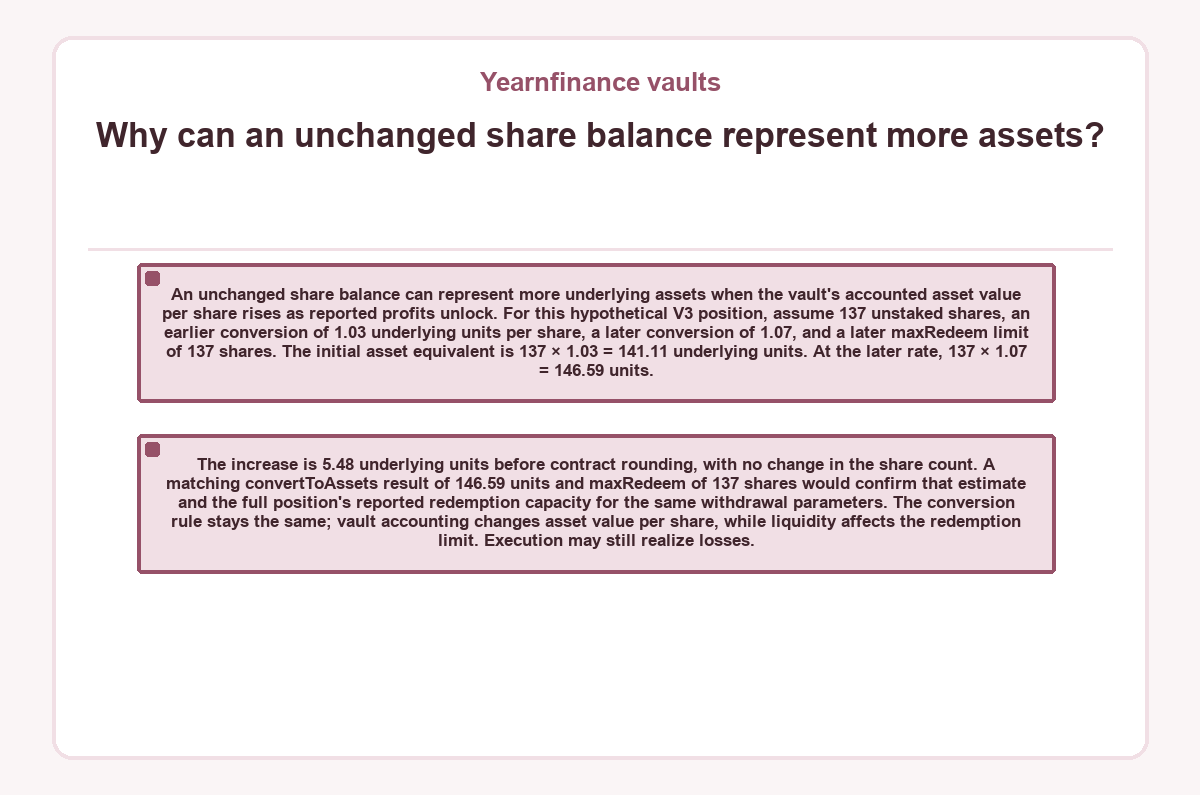
A matching
convertToAssets
result of 146.59 units and
maxRedeem
of 137 shares would confirm that estimate and the full position's reported redemption capacity for the same withdrawal parameters. The conversion rule stays the same; vault accounting changes asset value per share, while liquidity affects the redemption limit. Execution may still realize losses.
The deposit token sets the position's exposure
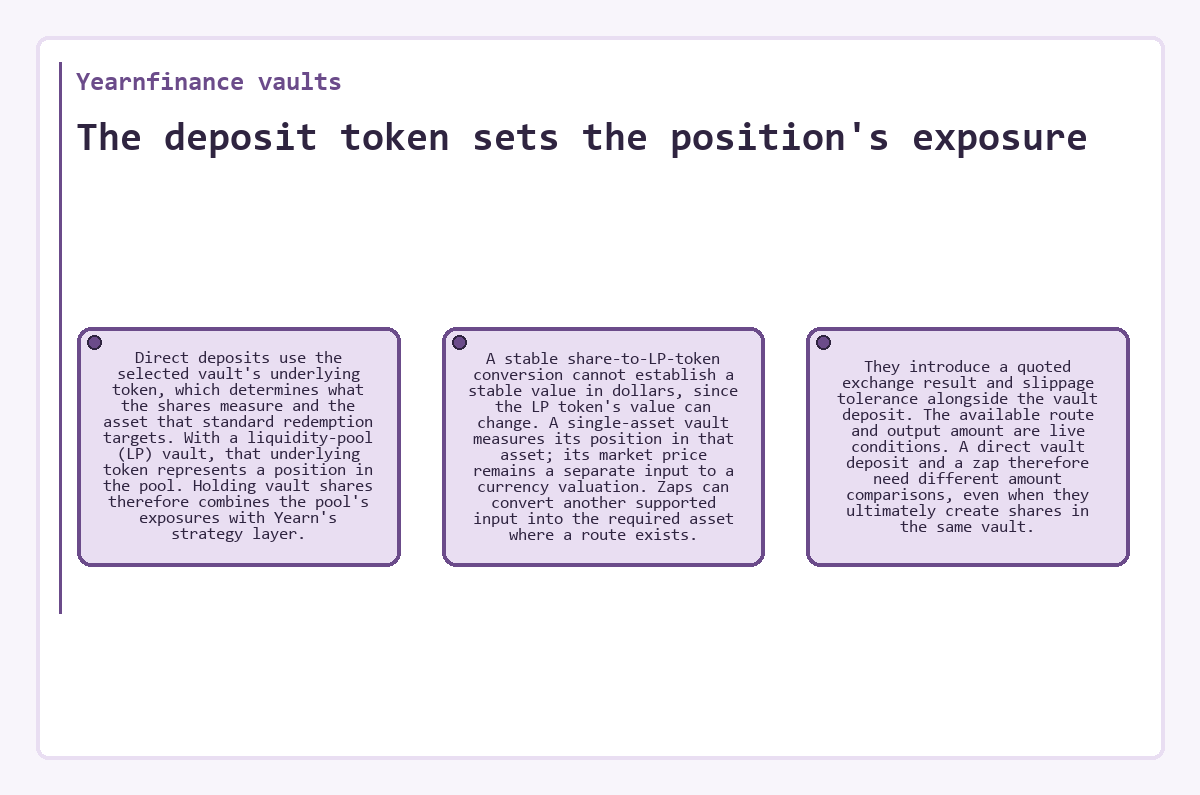
Direct deposits use the selected vault's underlying token, which determines what the shares measure and the asset that standard redemption targets. With a liquidity-pool (LP) vault, that underlying token represents a position in the pool. Holding vault shares therefore combines the pool's exposures with Yearn's strategy layer. A stable share-to-LP-token conversion cannot establish a stable value in dollars, since the LP token's value can change. A single-asset vault measures its position in that asset; its market price remains a separate input to a currency valuation.
Zaps can convert another supported input into the required asset where a route exists. They introduce a quoted exchange result and slippage tolerance alongside the vault deposit. The available route and output amount are live conditions. A direct vault deposit and a zap therefore need different amount comparisons, even when they ultimately create shares in the same vault.
Strategy design changes the risks behind the shares
Lending, liquidity provision, and leverage expose vault shares to different loss mechanisms, so a common token standard cannot make their risks equivalent. A flaw in a vault, strategy, or underlying protocol can reduce the assets backing shares. Core-contract audits cover particular releases and do not establish audit coverage for every strategy.
Lending positions
Borrowing demand influences lending income, while high utilization can leave assets unavailable for withdrawal. Curation can adjust lending-market allocations and caps as liquidity changes. Those controls manage exposure; they do not ensure that already borrowed assets become immediately available.
Liquidity-pool strategies
Liquidity-pool strategies earn trading fees or protocol incentives. Relative token-price changes can cause impermanent loss, while reduced trading volumes can lower fee income. Reward-token prices and market liquidity also affect the amount that compounding produces. Each additional exchange or rewards contract adds a dependency.
Leverage and price feeds
Leveraged strategies depend on borrowing terms, collateral values, and price feeds. Sudden price moves or an incorrect oracle value can cause liquidation and penalties. Operational errors in managing debt create another failure route. These exposures belong to strategies that use leverage; they do not describe every vault.
Net APY reflects estimates and vault-level charges
The displayed net annual percentage yield (APY) estimates annualized yield after vault fees and includes compounding. Changes in assets per share reflect recognized performance, fees, and any profit unlocking.
Performance fees apply to earned yield. A management fee, where configured, applies over time to deposited capital and can dilute holders through newly minted shares. The applicable configuration belongs to the selected vault. Neither an older headline fee schedule nor another vault's settings establish this position's charges.
Historical measurement windows and harvest frequency influence the estimate, and different vault types can use different calculations. Gas costs for entering or leaving the position also affect the holder's outcome. A displayed annualized rate does not state the amount that a particular share balance will return on a particular withdrawal date.
V2 positions and term-based vaults have distinct exit mechanics
V2 LP vaults and specialized strategies require their own interpretation of the accepted asset, compounding process, and exit value.
V2 supports up to 20 strategies and handles Curve, Velodrome, and Aerodrome LP positions. It does not use the ERC-4626 interface that defines V3 integrations. A token-name prefix can help identify the family, but a withdrawal method must match the actual contract version. An LP-token redemption can leave the holder with a pool position that requires a separate pool exit.
Pendle-focused yPT vaults automate rollover between fixed-term positions. The underlying strategy's maturity still affects exit pricing: withdrawing far from that maturity can produce an unfavorable price. Automated rollover therefore manages term changes without fixing every possible early-exit value.
Redemption turns share value into available assets
Redemption needs accessible underlying assets as well as a share balance, and V3 exposes different limits for share-based and asset-based exits.
redeem
specifies shares to burn, while
withdraw
specifies the underlying asset amount requested before any permitted withdrawal losses.
maxRedeem
and
maxWithdraw
expose the corresponding address-specific limits. High utilization in an underlying lending market can constrain exits, even while its recorded position retains value. Staked vault shares must leave the rewards staking contract before their holder can redeem those shares through the vault.
An Allocator Vault may also accept an ordered list of withdrawal strategies, with up to 10 addresses. That list overrides
default_queue
only when
use_default_queue
is
False
. A caller cannot assume that supplying a different order changes a vault that forces its default queue.
For direct V3 contract calls, the optional
maxLoss
parameter limits acceptable withdrawal losses in basis points and makes the transaction revert if loss exceeds that allowance.
For a V3
redeem
call that omits
maxLoss
, the default allowance is 10,000 basis points.
That permits losses up to 100%, so a lower explicit tolerance caps acceptable withdrawal loss. The corresponding
withdraw
default permits 0 basis points of loss.
Questions and answers about Yearnfinance vaults
Can a contract built with Yearn V3 be absent from the Yearn vault list?
Yes, anyone can deploy a V3 strategy or manage a vault, so using the core contracts does not establish Yearn deployment or endorsement. A registry records endorsed vaults on a particular chain. Its vault information includes the asset, release version, and vault type, which distinguish the deployments without relying on token names alone.
Which contract value identifies a V2 vault when the token name is unclear?
When distinguishing V2 from V3 vaults, apiVersion values beginning with 0 identify V2, while values beginning with 3 identify V3. Examples include 0.4.6 for V2 and 3.0.4 for V3. These are release identifiers that determine the applicable contract interface, so a token-name prefix alone cannot replace the version value.
Why can a V3 deposit approval succeed without creating vault shares?
In a direct V3 deposit, approval authorizes the vault to transfer the underlying token, while deposit creates vault shares. A successful approval alone therefore leaves the deposit unfinished. The deposit must also satisfy the vault's limit for the intended share receiver, which maxDeposit exposes. An allowance and a share balance describe different contract states.
Are V3 share-conversion functions suitable as an onchain price oracle?
V3 conversion functions require security analysis before another protocol relies on them for onchain pricing. Their availability alone does not establish resistance to manipulation in that use. The legacy pricePerShare helper has precision limitations and is intended for offchain use. V3 also provides the standard convertToAssets and convertToShares functions for share and asset conversions.
When does a Convex strategy show a zero net APY?
For the Curve-vault APY calculation that uses Convex Finance rewards, frozen reward streaming makes the displayed net APY zero until streaming resumes. This display condition concerns that calculation, rather than the amount of underlying assets represented by a share. A zero rate by itself therefore does not establish the value that a redemption would deliver.
Will redeeming yvyCRV release the locked CRV?
A standard yvyCRV redemption targets yCRV; it does not release the CRV locked behind that token. The auto-compounder reinvests rewards into more yCRV. Exchanging yCRV for CRV requires a market trade at the available price. The names yvyCRV and st-yCRV refer to the same auto-compounding vault, despite the different labels.