 Yearnfinance
 YFI staking claims and cooldowns
Yearnfinance offers YFI governance staking through stYFI and stYFIx, with separate reward claims and a cooldown for withdrawing principal. stYFI retains direct governance rights, while stYFIx delegates voting power. Both routes pay claimable rewards in yvUSDC, a Yearn vault token. Unstaking starts a 14-day linear release of YFI, allowing withdrawals as funds unlock. Adding another unstaked amount to an active cooldown resets the release timer for its entire balance and relocks any portion that was already available for withdrawal.
Adding another amount to an active stYFI or stYFIx cooldown resets the release timer for its entire balance and relocks any already withdrawable YFI.
Staking YFI with direct or delegated voting
With YFI available on Ethereum mainnet, the choice between stYFI and stYFIx determines how the resulting position handles voting power. The input asset stays the same. Staking mints stYFI when the holder chooses direct governance, or stYFIx when the holder chooses delegation. Neither an approval request nor an approved allowance establishes that staking has finished; the staking transaction must mint the selected token.
Use the intended governance role to choose the position, then follow the corresponding approval and staking flow:
- Choose stYFI when retaining direct governance rights is the requirement.
- Choose stYFIx when delegating voting power is the requirement.
- Approve YFI for the selected staking contract before submitting the stake.
- Confirm that the completed staking transaction minted the token that matches the selected route.
The cooldown releases YFI gradually
Unstaking stYFI or stYFIx starts a 14-day linear cooldown. The release begins during that period, so the holder can withdraw the currently unlocked amount before the full balance becomes available. This timing rule concerns the YFI principal placed into cooldown.
Release timing and additions to the cooldown
An unchanged cooldown balance
When no additional amount enters the active cooldown, time progressively increases the unlocked portion. Previously withdrawn YFI is no longer part of the remaining claim.
A partially unlocked position contains both available YFI and a remainder still moving through the release period. Withdrawing the available portion does not make the remainder immediately accessible.
An additional amount in the same cooldown
Adding more YFI to an active cooldown resets the timer for the entire cooldown position. The reset covers the existing balance plus the new amount. Any portion that was already withdrawable becomes locked again, so the effect extends beyond the newly added YFI.
Available YFI can be withdrawn before another amount enters cooldown. Leaving that available portion inside the position exposes it to the reset. The order matters because the contract applies the renewed timer to the combined cooldown balance.
Reward claims deliver yvUSDC separately from principal
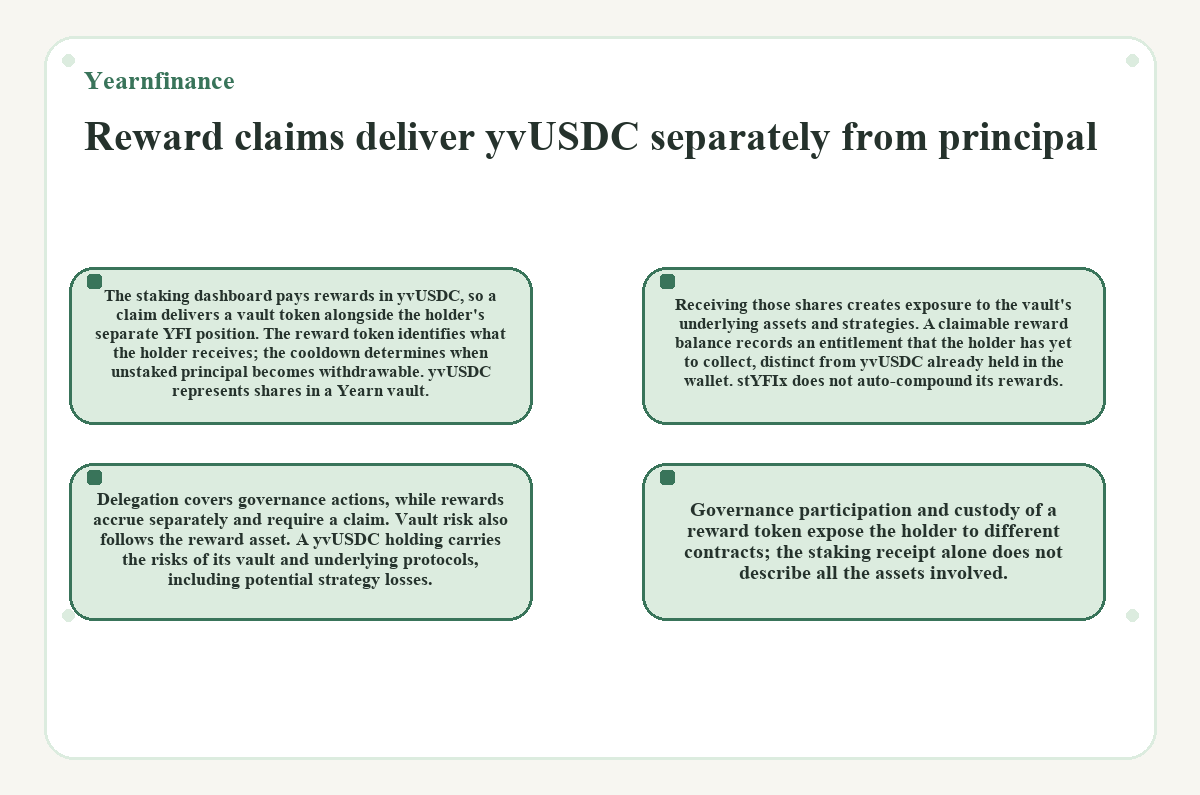
The staking dashboard pays rewards in yvUSDC, so a claim delivers a vault token alongside the holder's separate YFI position. The reward token identifies what the holder receives; the cooldown determines when unstaked principal becomes withdrawable.
yvUSDC represents shares in a Yearn vault. Receiving those shares creates exposure to the vault's underlying assets and strategies. A claimable reward balance records an entitlement that the holder has yet to collect, distinct from yvUSDC already held in the wallet.
stYFIx does not auto-compound its rewards. Delegation covers governance actions, while rewards accrue separately and require a claim.
Vault risk also follows the reward asset. A yvUSDC holding carries the risks of its vault and underlying protocols, including potential strategy losses. Governance participation and custody of a reward token expose the holder to different contracts; the staking receipt alone does not describe all the assets involved.
Mainnet transaction costs affect each contract interaction
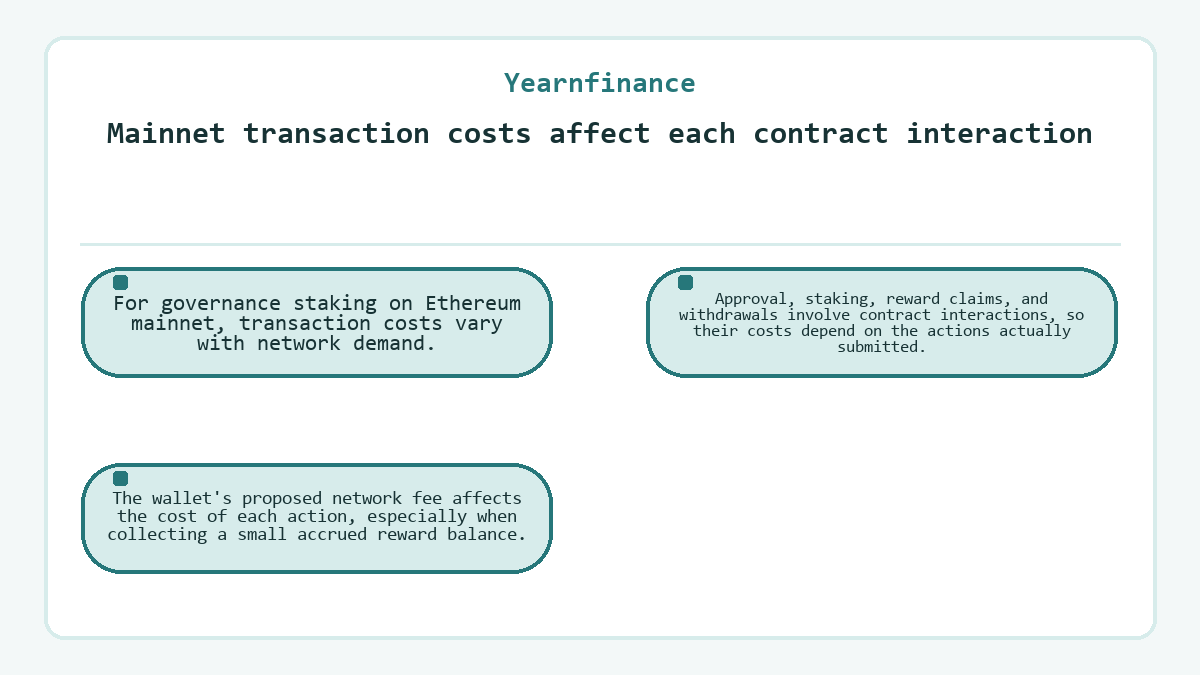
For governance staking on Ethereum mainnet, transaction costs vary with network demand. Approval, staking, reward claims, and withdrawals involve contract interactions, so their costs depend on the actions actually submitted. The wallet's proposed network fee affects the cost of each action, especially when collecting a small accrued reward balance.
Legacy veYFI locks have a separate migration path
A legacy veYFI lock may qualify for migration into the stYFI system and activation of a dashboard boost. Its presence does not, by itself, show that migration or boost activation has completed. veYFI is a legacy locked YFI derivative, while the current system centers on stYFI and stYFIx. Historical veYFI instructions remain relevant to a legacy balance, but their reward mechanics do not describe a fresh stYFI stake. The current exit mechanism releases unstaked YFI through the linear cooldown.
Similar staking labels can describe different exit rights
In the yCRV system, YearnBoostedStaker permits unstaking yCRV without a staking lock-up or penalty. That action returns the liquid locker token. It does not redeem the underlying CRV that backs yCRV, which remains locked. The yCRV auto-compounding vault claims rewards, swaps them into more yCRV, and reinvests through the staking system. stYFIx delegates governance while leaving rewards to be claimed separately.
The auto-compounding yCRV vault uses the name yvyCRV, also historically called st-yCRV.
Before you start with Yearnfinance
Does the stYFI interface request an unlimited YFI approval?
The stYFI interface uses exact-amount YFI approvals for the selected staking contract, authorizing the specified amount without requesting an unlimited allowance.
Can a new YFI stake use stYFIx without a legacy veYFI lock?
The ordinary stYFIx staking flow accepts YFI without requiring a legacy veYFI lock. Staking mints the delegated-governance token after the required approval. The legacy migration route concerns an existing lock and possible boost activation, so those migration conditions do not apply to an ordinary new stake.
Is a dYFI reward range a quote for current stYFI rewards?
A dYFI reward range in legacy veYFI material describes that earlier incentive system. Current stYFI staking pays claimable rewards in yvUSDC. An old boost multiplier or historical rewards percentage therefore does not establish the amount that a current stYFI or stYFIx position will receive.
What determines the USDC value of a claimed yvUSDC balance?
The USDC amount represented by yvUSDC depends on the number of shares and the vault's assets per share. The share count alone does not establish the underlying amount. Its dollar value also depends on USDC's market price, while withdrawal conditions affect access to the vault assets.
Does a V3 vault audit also cover the stYFI staking contract?
A V3 vault audit covers the specified vault-core release, so that audit alone does not establish coverage of governance-staking contracts. The code and version under review determine its scope. A cooldown controls the timing of YFI release; it does not insure the principal against a contract failure.