 Yearnfinance
 fees reduce vault returns while gas adds transaction costs
Yearnfinance fees apply to vault profits or managed assets, while network gas separately covers blockchain transactions. Rates vary by vault, version, and configuration. Net APY accounts for vault fees and compounding, but personal transaction costs and any asset conversion still affect the amount retained.
Bottom line: A vault's net APY already accounts for its fees; subtracting those fees again understates the quoted return before personal transaction costs.
Profit and elapsed time set different fee bases
A larger recognized profit increases a performance charge at the same configured rate. A longer accrual period increases a time-based management charge when its rate and fee base remain unchanged. Comparing those percentages requires knowing what each percentage measures.
Performance fees follow eligible profits
For a performance rate expressed as a fraction, the charge equals eligible profit multiplied by that rate. The same rate produces different fee amounts when profits differ. It does not imply that percentage of deposited principal leaves the position. In share-based fee accounting, the contract mints shares for fee recipients. Existing holders can therefore keep the same share count while those new shares reduce their proportional ownership.
Management fees follow assets and time
A management fee uses an annual rate and elapsed time against an asset balance. The standard mechanism prorates that annual charge over the accrual period, with the contract fixing the precise balance and timing. Minting fee shares dilutes existing holders instead of producing a separate wallet payment. Single-asset yVaults generally have no management fee, but each vault has its own settings. V3 accountants can implement customized charging logic. A zero management rate leaves performance fees and transaction costs as separate considerations.
V3 distinguishes protocol fee shares from additional vault charges
V3 can assess fees inside a Tokenized Strategy and through an Allocator Vault's accountant. The protocol share concerns how collected fees divide between recipients; the accountant determines any additional charges at the allocator level.
The protocol receives a share of existing fees
In V3, the protocol fee is a percentage of fees already charged. A Tokenized Strategy divides its performance-fee shares between the protocol recipient and its performance-fee recipient. An Allocator Vault applies the protocol percentage to fees returned by its accountant. Adding that protocol percentage directly to a performance percentage would mix different denominators. The applicable factory configuration determines the protocol share for the relevant deployment.
Strategy and allocator accounting can charge at different levels
An Allocator Vault needs an accountant to charge its own fees; its core default is zero at that level. Strategies beneath it may still charge performance fees. Their charges affect the strategy value that the allocator holds, while its accountant can assess further fees. Comparing direct strategy ownership with an Allocator Vault therefore requires the settings at both levels. Neither the shared underlying asset nor ERC-4626 compatibility establishes an identical total fee burden.
Timing also varies. Tokenized Strategy v3.0.4 assesses performance fees at reports. Version v3.1.0 retains that default and supports live accrual when a strategy overrides its asset-valuation callback, allowing fee assessment between reports.
Does net APY include every cost of using a vault?
Net annual percentage yield accounts for vault fees and compounding, while personal gas spending and entry or exit conversions remain outside that vault return. Subtracting the same performance or management charge again would double-count it. Gross annual percentage rate, by contrast, describes returns before fee deductions. An annualized percentage also differs from the return earned over a shorter holding period.
Historical share-price changes often inform the displayed estimate. Reporting cadence and the selected measurement window can make it change even without a new fee setting. Net APY therefore describes an estimated annualized vault return, rather than a fixed payment on a particular deposit. A personal return calculation also needs the actual holding period and the cost of converting between the starting and ending assets.
Network gas changes the economics of frequent transactions
Each additional onchain transaction can add network costs without changing the vault's performance or management rate. Approvals, deposits, and withdrawals can each consume gas, depending on the route and existing allowances. Ethereum mainnet congestion changes transaction prices, while the contract interaction determines the work required. Shared vault operations spread strategy transaction costs across pooled capital. Personal approvals and redemptions still involve account-specific transactions. A wallet's estimate concerns the selected transaction on that network, leaving later withdrawals and additional conversions as separate costs.
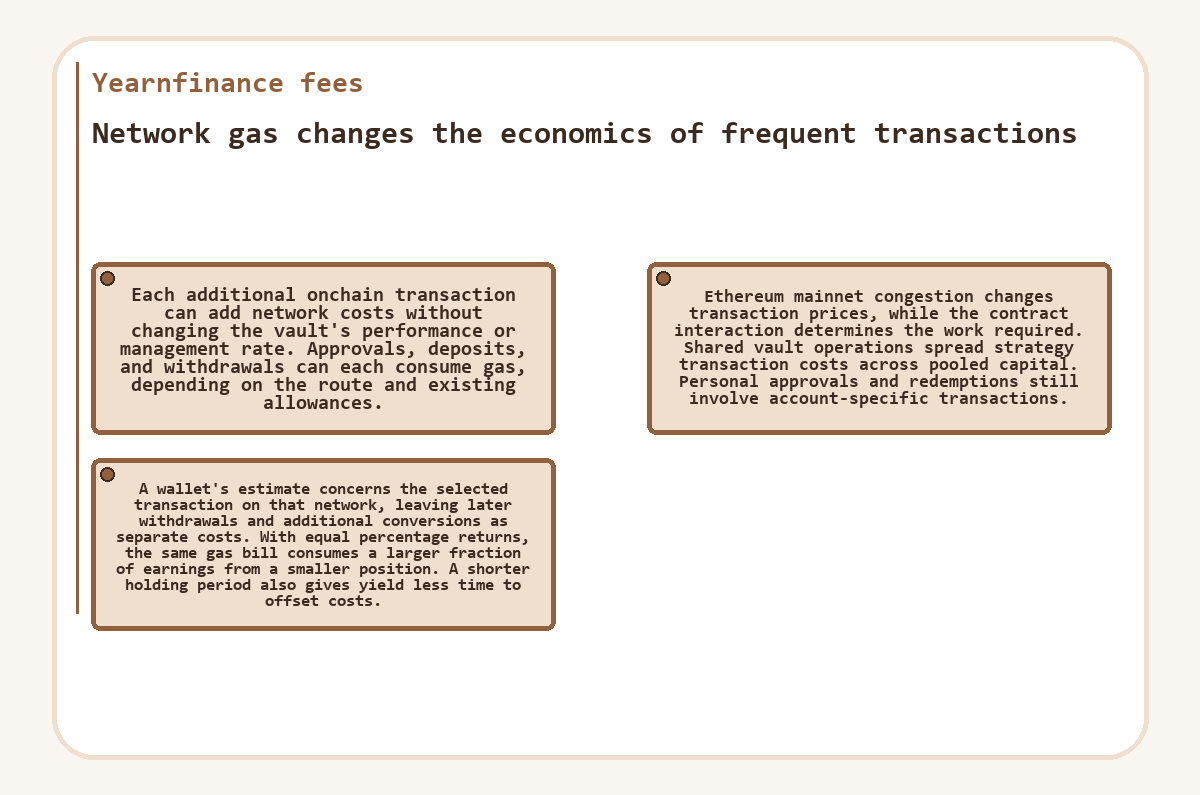
With equal percentage returns, the same gas bill consumes a larger fraction of earnings from a smaller position. A shorter holding period also gives yield less time to offset costs.
Direct deposits, zaps, and share swaps carry different execution costs
The selected route changes which conversions accompany entry or exit, even when the destination vault stays the same. Direct interaction uses its underlying asset. Some vaults also support zaps involving other assets, and third-party services can provide routes for trading vault shares.
| Entry or exit option | What determines the execution cost |
|---|---|
| Direct deposit or redemption | Network gas for the required contract interactions; a direct route uses the vault's underlying asset. |
| Zap involving another asset | The available conversion route, quoted output, slippage setting, and network costs. |
| Market swap of vault shares | The third-party trading route and its quoted exchange terms for the selected output. |
A zap's slippage setting limits acceptable deterioration from the quoted output. It does not describe a performance fee. Likewise, a market quote for vault shares can reflect exchange conditions alongside their underlying asset value. Comparing routes requires matching the starting asset, final asset, and quantity under consideration. Outputs denominated in different tokens cannot be compared by token count alone.
Conversion costs also depend on what the position holds. A vault whose underlying asset is a liquidity-pool token returns exposure to that pool through direct redemption. Exchanging that token for another asset introduces a separate pricing question.
Withdrawal losses can resemble an exit charge
Lower withdrawal proceeds can reflect strategy losses or execution prices, separately from an explicit fee. V2 removed the withdrawal fee used in V1. Gas and any conversions still affect an exit, while losses in underlying positions can reduce the assets available for redemption.
The
V3 Allocator Vault
v3.0.4 three-argument
redeem
call defaults to allowing losses of 100% of the calculated redemption value.
Its three-argument
withdraw
call defaults to a 0% tolerance. An explicit
max_loss
parameter sets the acceptable loss in basis points. The contract reverts when losses exceed that limit. These are contract-call defaults; a frontend or router may pass a different explicit value. The tolerance controls accepted loss and does not set a withdrawal fee.
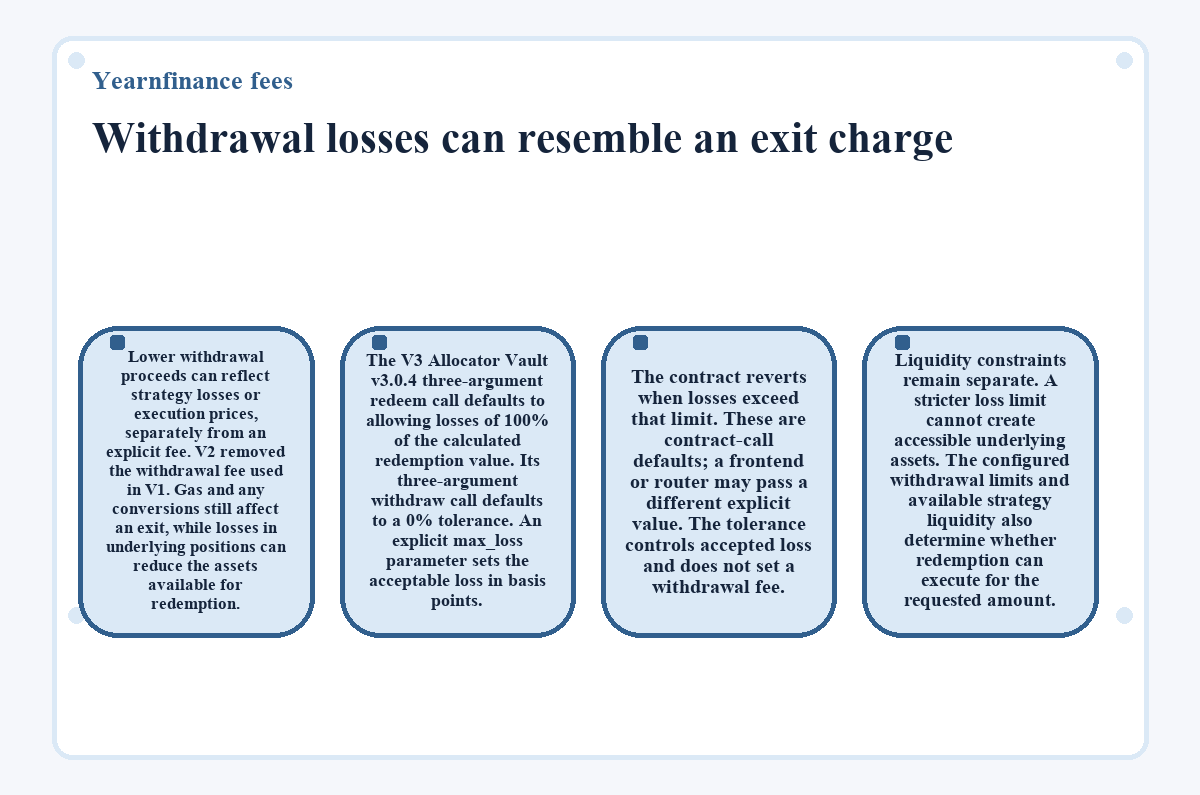
Liquidity constraints remain separate. A stricter loss limit cannot create accessible underlying assets. The configured withdrawal limits and available strategy liquidity also determine whether redemption can execute for the requested amount.
yCRV revenue and auto-compounding have separate fee layers
The yLocker fee schedule charges 10% of weekly revenue, while its auto-compounding vault has a separate performance fee.
The yLocker charge applies to weekly revenue
yCRV receives income associated with locked Curve governance positions, including protocol fees and voting incentives. Its yLocker performance charge applies to the revenue received each week. Direct staking through YearnBoostedStaker distributes stablecoin-denominated rewards through Yearn vault tokens. The percentage therefore describes a charge on product revenue. It does not describe a weekly deduction of that percentage from the holder's entire yCRV balance.
The auto-compounding vault charges on its own yield
The yCRV auto-compounder claims staking rewards, exchanges stablecoins for additional yCRV, and restakes the tokens. That additional vault layer charges a performance fee on its earnings. Adding the upstream and downstream percentages does not establish a flat percentage charge on deposited capital. The auto-compounder's whitelist gives reinvested tokens maximum staking boost immediately. New direct stakes build their boost over time and leave reward claims as manual actions.
For the yCRV auto-compounding configuration described here, the additional vault performance rate is 10%.
Yearnfinance fees: quick answers
Are the old 20% performance and 2% management rates universal?
The 20% performance and 2% annual management schedule predates the dynamic fee structure adopted through YIP-69. Those figures describe a historical schedule, not a quote for every vault. The selected vault's version and configured parameters determine the applicable charges. Applying a copied historical rate can therefore misstate costs even when the underlying token stays the same.
Does a vault-specific V3 protocol fee override create a new recipient?
A custom protocol rate does not by itself change the protocol fee recipient. In the VaultFactory configuration that supports per-vault overrides, the configured protocol recipient remains the default for custom-rate vaults. The override selects a percentage, while the recipient field specifies the destination. The relevant factory must correspond to the vault's API version and deployment.
Can staked vault shares require extra gas before redemption?
Staked vault shares can add gas costs when an exit requires a separate unstaking transaction. The vault-share balance and rewards-contract balance represent different positions in that situation. A displayed exit amount alone therefore does not establish the transaction count or total network cost.
Why might a Curve factory vault withdrawal leave another conversion cost?
A Curve factory vault can return its underlying Curve liquidity-pool token, leaving pool redemption as a separate operation. Converting that LP token into its component assets can require another onchain interaction with its own gas cost. The vault withdrawal and pool withdrawal involve different contracts, so the cost of one interaction does not automatically cover the other.
When can a yPT withdrawal create a cost beyond vault fees?
A yPT withdrawal can obtain an unfavorable price when it occurs far from the underlying Pendle strategy's maturity date. That price effect comes from exiting the term position. The vault's automatic rollover does not establish a uniform exit value throughout each term. Network gas and configured vault fees remain separate parts of the cost assessment.
Is yCRV's 1:1 minting rate also a guaranteed exit rate?
The 1:1 CRV-to-yCRV minting rate does not guarantee the rate for a later market sale. yCRV cannot be redeemed for the locked CRV, so a sale uses available exchange liquidity and market pricing. A difference from the minting ratio is a trading-price effect, separate from the performance fee on yLocker revenue.
Will Yearn vault fees cover losses from a smart contract failure?
Yearn vault fees do not include a commitment by contributors or YFI holders to reimburse losses. Smart contract or underlying-protocol failures can reduce vault assets, even when the user submits the intended transaction.